-1.jpg)
Share
Inconsistent sales processes don't just hurt individual sales performance-they silently undermine forecasting accuracy, pipeline reporting, onboarding speed, customer experience, and an organisation's ability to scale. The root cause is rarely the CRM. It's the absence of a standardised commercial framework that all salespeople operate from.
Picture this scene. A leadership team gathers to review the quarterly sales pipeline. The numbers are in the CRM. The stages are labeled. Everything looks structured on the surface.
Then the questions start.
"What does 'Proposal Sent' actually mean here - has this been formally scoped or just discussed?"
"Why is this deal marked at 80% confidence when we haven't had a conversation with the decision-maker?"
"Is this one forecast for the quarter or aspirational?"
Different answers come back from different people.
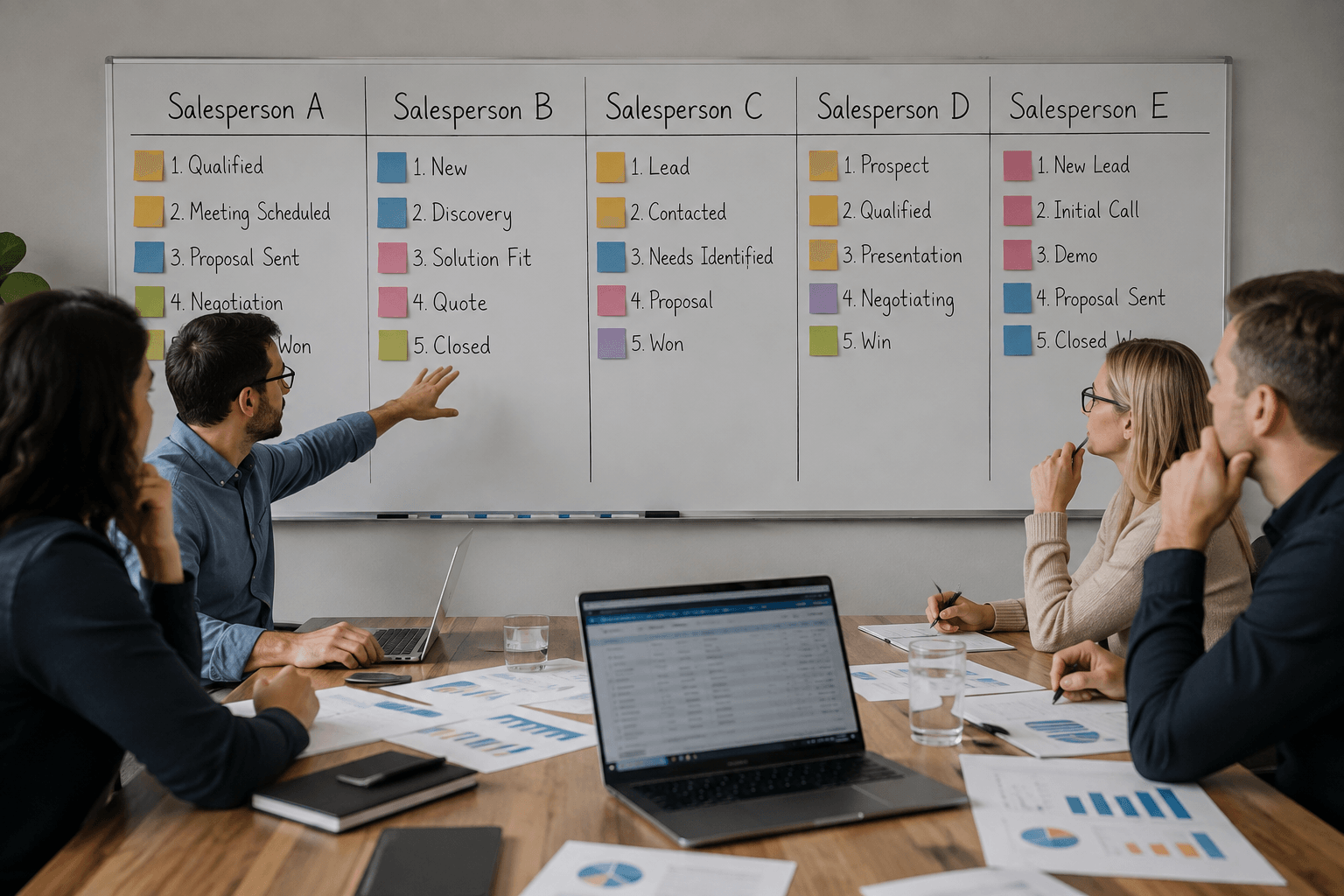
The CRM isn't the problem. The pipeline data is being entered correctly. The issue is that every salesperson has developed their own version of how the process works - their own qualification criteria, their own definition of deal stages, their own approach to forecasting. The organisation believes it has one sales process. In reality, it has several running in parallel.
That gap between what's documented and what's actually practiced is where the real cost accumulates.
What Causes Sales Processes to Drift Toward Inconsistency?
Inconsistency rarely happens overnight, and it rarely happens because of poor intent.
It develops gradually as organisations grow. New salespeople join and learn from the person sitting next to them, not from a documented process. Senior reps develop habits that work for their style and their customer relationships. Managers, stretched thin, coach to outcomes rather than process.
Over time, each salesperson builds their own operating model:
- Their own criteria for qualifying an opportunity
- Their own follow-up cadence
- Their own approach to proposals and pricing conversations
- Their own interpretation of CRM stages
- Their own confidence levels when forecasting
- Their own way of managing deals through to close
None of this is a reflection of individual competence. Most of these salespeople are performing. The problem is that a collection of individual approaches is not a commercial operating model - and treating it like one creates significant downstream risk for the business.
The Hidden Costs That Leadership Often Underestimates
This is where the conversation needs to shift from individual performance to organisational architecture. Inconsistent sales processes don't just affect win rates. They create structural problems across multiple functions.
Why Does Sales Forecasting Become Unreliable?
Forecasting depends on one foundational assumption: that a deal at a given pipeline stage carries a predictable probability of closing. When ten salespeople define "Negotiation" ten different ways, that assumption breaks down.
One salesperson moves a deal to "Negotiation" when verbal interest has been expressed. Another won't move it until commercial terms are being actively discussed. The pipeline looks healthy. The forecast reflects confidence. But the underlying data is measuring ten different things.
Leadership is then asked to make resourcing, hiring, and investment decisions based on a number that nobody can confidently defend. That's not a data problem. It's a process problem presenting itself as a data problem.
How Does It Compromise Sales Reporting and Leadership Visibility?
The downstream effect of inconsistent deal stages is that sales reporting becomes difficult to trust.
When leadership reviews conversion rates, average deal velocity, or win/loss data, those metrics only carry meaning if the inputs are consistent. If "Qualified" means something different depending on who owns the deal, conversion rates from Qualified to Proposal are measuring noise, not signal.
Leaders end up making commercial decisions - territory planning, product positioning, sales strategy - on data that reflects process variation rather than market reality. The reporting looks clean. The insights it produces aren't.
What Is the Real Cost of Longer Sales Onboarding?
When a new salesperson joins a business without a documented commercial process, they don't learn from a system. They learn from people.
They shadow the rep with the available calendar. They pick up that rep's habits, language, and interpretation of what each pipeline stage means. If that rep has idiosyncratic practices - some effective, some not - those get passed on as standard.
Onboarding time extends because new hires are assembling a process from fragments rather than following a defined framework. More critically, each new hire enters the team with a slightly different operational foundation. The inconsistency compounds with every hire.
organisations that have standardised their commercial process can onboard salespeople faster and with significantly more confidence that they'll operate in a predictable way from day one.
How Does Sales Process Inconsistency Affect the Customer Experience?
The buying journey a customer experiences should not depend on which salesperson they happen to engage with.
But without a consistent commercial framework, it does. Qualification conversations vary. Proposal formats differ. Handover from sales to implementation or customer success follows no standard structure. Some customers receive a thorough, well-managed buying experience. Others encounter gaps, repetition, or confusion.
From the customer's perspective, this feels like organisational disorganisation - even when the individual salesperson is doing their best work. That perception affects both conversion and retention.
Why Does Coaching Break Down Without a Shared Benchmark?
Effective sales coaching requires a shared language and a common standard to coach against.
When every salesperson has developed their own approach, coaching conversations become subjective. Leaders can identify that a rep is underperforming, but diagnosing where the breakdown is occurring - qualification, discovery, proposal, negotiation - requires a consistent process to compare against.
Without that benchmark, coaching tends to focus on outcomes rather than process, on results rather than the underlying behaviours that create them. The conversations happen. The improvement is harder to measure and harder to sustain.
Why Implementing a CRM Doesn't Solve This Problem
This is a point that matters significantly for any organisation planning a CRM implementation or optimis an existing platform like HubSpot.
Software reflects the commercial process that already exists. HubSpot, Revenue Hub, Salesforce - these platforms are powerful. But they are neutral instruments. They capture what salespeople do. They don't standardise it.
If the underlying process is inconsistent, a CRM implementation doesn't resolve that inconsistency. It makes it more structured and more visible. The data is entered more reliably. The reporting is easier to generate. But the variation in how deals are qualified, staged, and forecast is preserved - and in some cases, amplified - because the system has been configured around a fragmented process.
Organisations that invest in CRM optimisation before addressing commercial process design often find themselves with better-looking dashboards and the same underlying problems. The technology isn't failing. It's doing exactly what it was configured to do.
Commercial architecture has to come first. Technology configuration follows.
What High-Performing Sales organisations Actually standardise
The goal is not to turn salespeople into process-followers who leave personality at the door. Relationships, judgment, and adaptability still drive deals. The goal is to give every salesperson a shared commercial framework to operate within - so that the organisation's pipeline, forecast, and reporting data reflects reality.
High-performing sales organisations typically standardise:
-
Opportunity qualification criteria - a shared definition of what makes a deal worth pursuing
-
Entry and exit criteria for each pipeline stage - so that a deal at "Proposal" means the same thing regardless of who owns it
-
Forecast categories - distinguishing between committed, likely, and upside in a consistent way
-
Required CRM fields - ensuring the data captured is complete, consistent, and reportable
-
Pricing governance and discount approvals - preventing revenue leakage and protecting margin
-
Proposal workflow - a consistent structure for how commercial proposals are built and delivered
-
Customer handover process - ensuring the transition from sales to delivery or customer success is managed consistently
Standardisation creates a repeatable system. That system is what allows an organisation to scale without losing control of its commercial data, its forecasting, or its customer experience.
Building a Commercial Architecture That Scales
Businesses don't scale through individual heroics. They scale through repeatable commercial systems.
The organisations that grow sustainably-and maintain confidence in their pipeline and revenue data-are the ones that treat sales process design as a strategic priority, not an afterthought. They invest in defining how opportunities are qualified, how deals progress, how forecasts are constructed, and how customers are handed over. Then they configure technology around that framework.
This distinction matters more than it might appear. A well-configured HubSpot CRM, built on a consistent commercial process, gives leadership accurate forecasting, reliable reporting, and a coaching foundation that works. The same CRM, configured on top of an inconsistent process, gives leadership better-presented uncertainty.
The question for any organisation reviewing its sales operations-or considering a CRM implementation-is not whether the technology is capable enough. It is whether the commercial process is consistent enough to make that technology meaningful.
Start with the process. Define the framework. Then configure the system.
If your organisation is preparing toimplement HubSpot or reviewing how your sales operations are structured, Engaging Partners works with commercial teams to design the process architecture before any technology is configured.
Book a free 30-minute Strategy Call
Frequently Asked Questions
What is a sales process, and why does consistency matter?
A sales process is the sequence of steps a salesperson follows to move an opportunity from initial contact to close. Consistency matters because it ensures that pipeline stages, deal forecasts, and sales data mean the same thing across the entire team-making reporting and decision-making reliable.
How does an inconsistent sales process affect sales forecasting?
When salespeople define pipeline stages differently, deals at the same stage carry different levels of actual progress. This makes forecast data unreliable, because the confidence percentages attached to each stage no longer reflect a predictable commercial reality. Leadership ends up making decisions on data that measures process variation rather than genuine deal health.
Can a CRM like HubSpot fix inconsistent sales processes?
No. HubSpot and similar CRM platforms capture and organize the commercial process that already exists. If that process is inconsistent, a CRM will record inconsistent data more efficiently-not eliminate the inconsistency. Commercial process design must precede CRM configuration to produce meaningful results.
What are the signs that a business has an inconsistent sales process?
Common indicators include: pipeline reviews where deal health is unclear, forecasts that regularly miss by a wide margin, new salespeople taking significantly longer than expected to reach full productivity, variable customer experiences during the buying journey, and difficulty coaching to a consistent standard.
What should businesses standardise first when building a commercial framework?
The highest-impact starting points are opportunity qualification criteria and pipeline stage definitions with clear entry and exit criteria. These two elements directly affect forecasting accuracy, reporting reliability, and the quality of commercial data leadership depends on.
How does sales process standardisation support business growth?
Standardisation creates a repeatable operating model that new salespeople can be onboarded into quickly, that leaders can coach against consistently, and that scales without multiplying process variation. It allows the business to grow without lo